
IMO: International Mathematical Olympiad

Updated: Oct 17, 2021
The International Mathematical Olympiad (IMO) is a World Championship Mathematics Competition for High School students that takes place in a different country each year. The first IMO was held in 1959 in Romania, with participation from seven countries. It has steadily grown to encompass over 100 countries spanning five continents. The IMO Board of Directors guarantees that the tournament is held each year and that each host country adheres to the IMO's standards and traditions.

OBJECTIVES
This competition aims to:
to stimulate Enthusiasm and love and interest for mathematics;
to introduce important mathematical concepts;
to teach major strategies for problem solving;
to develop mathematical flexibility in solving problem;
to strengthen mathematical instruction;
to foster mathematical creativity and ingenuity; and
to provide for the satisfaction, joy and thrill of meeting challenges.
FORMAT OF THE CONTEST
Six problems comprise the competition. Each problem is worth seven points, adding up to a possible total of 42 points. Calculators are not allowed. The tournament lasts two days; each day, competitors get four and a half hours to answer three problems. The problems selected are drawn from a variety of fields of secondary school mathematics, including geometry, number theory, algebra, and combinatorics. They do not require advanced mathematics such as calculus or analysis, and their solutions are frequently elementary. They are, however, frequently camouflaged in order to make solutions more complex. The IMO's problems are mostly geared toward creativity and problem-solving ability. Thus, algebraic inequalities, complex numbers, and construction-oriented geometrical problems are heavily featured, however the latter has declined in popularity in recent years due to the algorithmic usage of theorems such as Muirhead's Inequality and Complex/Analytic Bash to solve problems.
Each participating country, excluding the host country, may submit suggested problems to the host country's Problem Selection Committee, which narrows the pool of submitted problems to a shortlist. The team leaders come a few days before the contestants to form the IMO Jury, which is responsible for all formal contest decisions, beginning with the selection of the six problems from the shortlist. The Jury's objective is to arrange the problems in increasing difficulty order: Q1, Q4, Q2, Q5, Q3 and Q6, with the First Day difficulties Q1, Q2, and Q3 being the most difficult, and the Second Day problems Q4, Q5, Q6 being the least difficult. The Team Leaders of all countries are notified of the contestants' difficulties in advance, ensuring that they are kept firmly separated and supervised.
Each country's marks are agreed upon by its leader, deputy leader, and coordinators provided by the host country (the leader of the team whose country submitted the problem in the case of the host country's marks), subject to the chief coordinator's judgments and, if necessary, a jury.
AWARDS
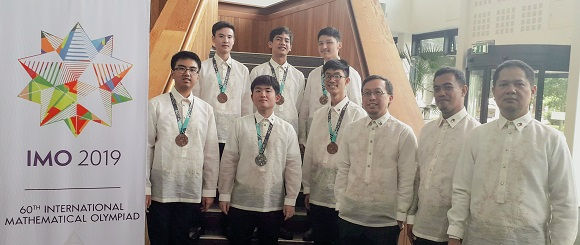
Participants are ranked according to their individual performance. Medals are given to the top-ranked competitors; somewhat less than half of them receive one. The cutoffs (minimum scores required to earn a gold, silver, or bronze medal) are then determined in such a way that the proportions of gold, silver, and bronze medals awarded are approximately 1:2:3. Honorable mention is given to participants who do not obtain a medal but score seven points on at least one task.
Special awards may be given for solutions that are particularly elegant or involve good generalizations of a problem. This occurred most recently in 1995 (Nikolay Nikolov, Bulgaria) and 2005 (Iurie Boreico, Italy), but was more common prior to the early 1980s. In 2005, the special prize was presented to Iurie Boreico, a Moldovan student, for his solution to Problem 3, a three-variable inequality.
The rule that at most half the contestants win a medal is sometimes broken if it would cause the total number of medals to deviate too much from half the number of contestants. This last happened in 2010 (when the choice was to give either 226 (43.71%) or 266 (51.45%) of the 517 contestants (excluding the 6 from North Korea — see below) a medal), 2012 (when the choice was to give either 226 (41.24%) or 277 (50.55%) of the 548 contestants a medal), and 2013, when the choice was to give either 249 (47.16%) or 278 (52.65%) of the 528 contestants a medal. In these cases, slightly more than half the contestants were awarded a medal.
For more information, visit http://www.imo-official.org/.



Comments